Bina içi yön bulmada
yapay zeka dönemi başlıyor:
Navigate Walk
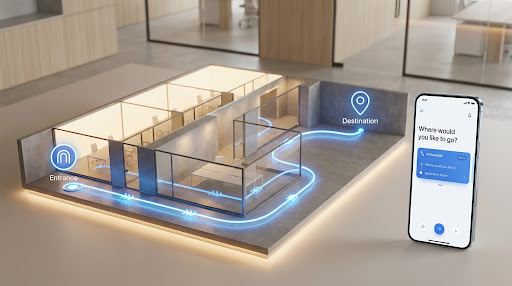
Navigate Walk uses AI-powered indoor navigation and voice guidance to help people move through complex spaces with greater confidence, clarity, and independence. Designed specifically for visually impaired individuals, ensuring no one is left behind in modern environments.
Location: Floor 2 · Corridor B
Where would you like to go?
Library
Continue straight for 15 meters.
Chat or speak — both work
Herkes Yolunu
Kolayca Bulabilsin.
Görme engelli ve az gören kişiler düşünülerek yapıldı. Duvarlardaki QR kodlarla konumunuzu alın, hedefe yazarak ya da sesle gidin.
Scan the QR on the Wall
QR codes placed on walls and key points tell the app exactly where you are inside the building—no GPS required.
Chat or Speak
After scanning, type your destination in the chat or say it out loud. Use whichever feels easier in the moment.
Get Your Route
The app calculates the path from your QR location and guides you step by step until you arrive.
Move Independently
Built for blind and low-vision users—and helpful for anyone who gets lost in large buildings.
Indoor Navigation is Broken. For Everyone.
Modern architectural scale has outpaced human orientation. When GPS signals terminate at the revolving door, indoor environments become bewildering obstacles—imposing acute anxiety on visually impaired guests and relentless confusion on first-time visitors.

Two parallel crises in the exact same facility: silent disorientation for low-vision individuals, and architectural maze fatigue for general visitors.
The Accessibility Void
For blind and low-vision individuals, entering a multi-floor facility without tactile paving or spatial audio cues creates immediate isolation. Traditional environments are completely silent, forcing dependence on strangers or security staff.
- close Absence of Non-Visual Cues: High-ceiling atriums eliminate natural acoustic boundaries while tactile floor strips are rarely installed.
- close Elevated Safety Anxiety: Unmarked temporary renovations, changing obstacles, and multi-tier escalators turn independent transit into a hazard.
- close Loss of Personal Autonomy: Everyday errands—like visiting a clinic or finding a lecture hall—require constant third-party escort.
The Labyrinth Syndrome
Massive healthcare networks, international transit terminals, and sprawling university complexes leave millions of sighted visitors perpetually disoriented. Static signage and archaic wall schematics fail when urgency matters most.
- close Cryptic Signage Overload: Inconsistent acronyms, multi-colored wing markings, and contradictory ceiling arrows induce cognitive fatigue.
- close Static 'You Are Here' Maps: Disorienting 2D floor plans provide zero real-time heading guidance, leading to missed appointments and transit delays.
- close Operational Friction: Staff spend up to 20% of their working hours giving directions instead of delivering primary services.
Simple Experience. Powerful Technology.
Navigate Walk translates complex environmental data into a seamless auditory journey. Here's how the interplay of QR markers, AI route generation, and real-time audio creates a fluid navigation experience.
Scan a QR Code
QR codes on walls and key points show your exact spot in the building. Open the app and scan the nearest one.
Chat or Speak
Type your destination in the chat, or say it out loud—for example: "How do I get to the library?"
Follow the Guidance
The app gives clear step-by-step directions from your QR location until you reach your destination.

Indoor Spaces Shouldn't Be Hard to Navigate.
Navigating large buildings can be disorienting — especially for those who cannot rely on traditional visual cues and maps. Navigate Walk removes these barriers, ensuring equal access across various complex environments by providing targeted solutions for specific challenges.
Universities
Navigate sprawling campuses effortlessly. Navigate Walk directs students across sprawling quads, identifies specific lecture halls across multiple interconnected buildings, and provides safe routes through complex library stacks.
Hospitals
Reduce stress in critical moments. Navigate Walk excels in routing patients and visitors through multi-floor hospital wings, guiding them accurately from the entrance to specific departments, elevators, and consultation rooms.
Public Buildings
Ensure accessible civic engagement. Navigate Walk clarifies complex administrative centers, guiding users through security checkpoints, to specific service counters, and accessible facilities with ease.
See Navigate Walk in your building.
Share a few details and we will get back to you to schedule a live demo.